
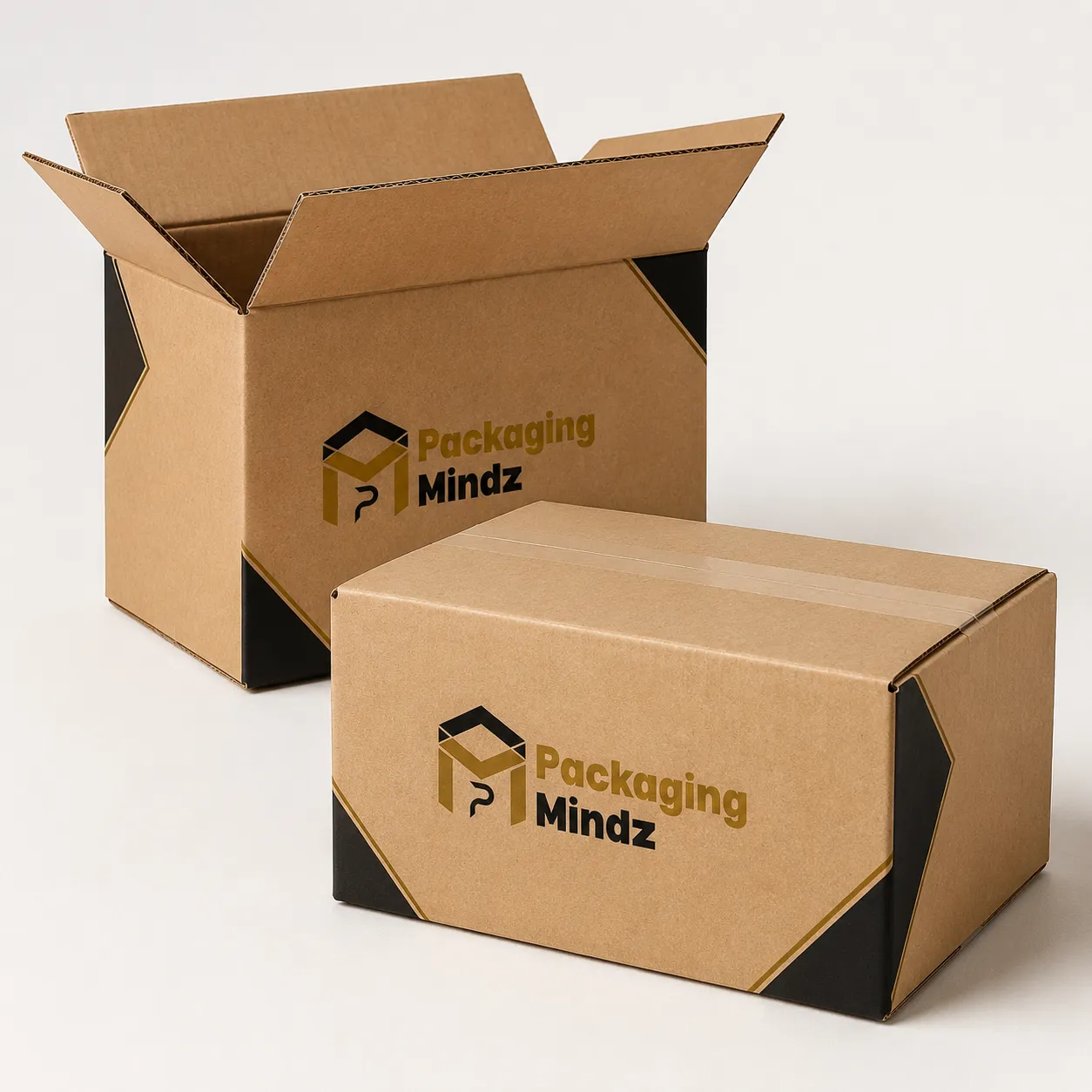
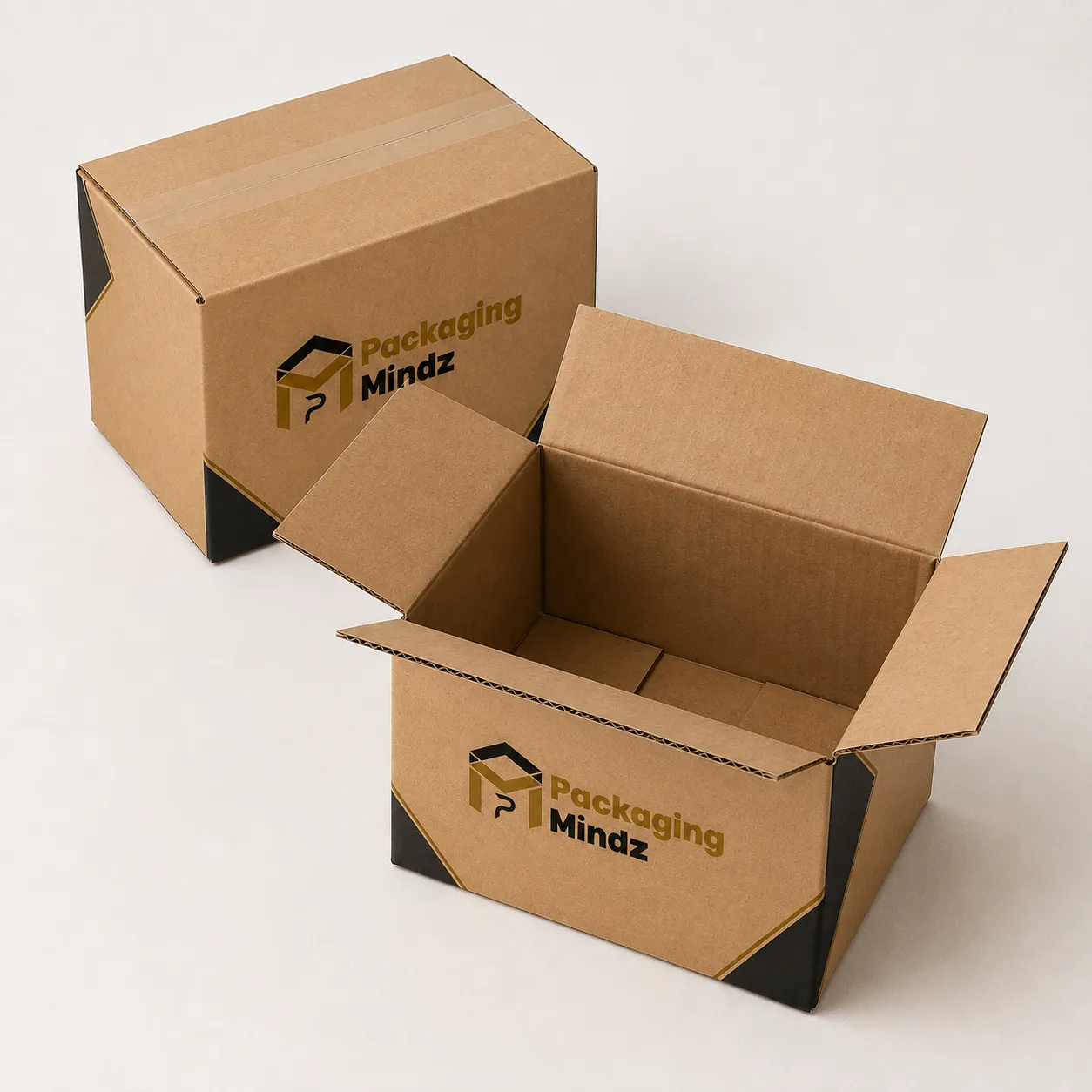
Description
Custom Shipping Boxes Designed Around the Entire Delivery Journey
The real test of a shipping box begins after it leaves your facility. Conveyor movement, stacked loads, warehouse handling, vehicle vibration, and doorstep delivery can all place pressure on the package. A visually attractive carton still falls short if its size or structure does not suit the packed product.
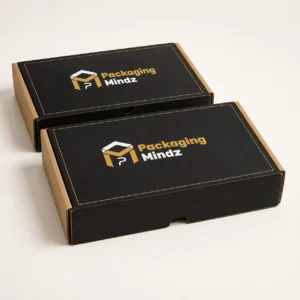
Packaging Mindz develops custom shipping boxes around your product dimensions, packed weight, fulfillment routine, presentation goals, and order volume. Choose plain corrugated cartons or custom printed shipping boxes featuring your logo, instructions, website, or branded artwork.
You do not need to determine every technical detail before requesting pricing. Send us the product information and explain how the order is packed. We can use those details to help shape the box specification.
Begin with What Goes Inside the Shipping Carton
Measuring the bare product is not enough. The internal dimensions must account for everything placed inside the final package, including retail cartons, wrapping, protective materials, promotional cards, and inserts.
Before requesting a quote, gather the following details:
- Product length, width, and height
- Total packed weight
- Number of items placed in each box
- Position or orientation of the products
- Existing retail or primary packaging
- Dividers, inserts, cushioning, or void fill
- Carrier label dimensions
- Preferred packing and closure method
A carton with excessive open space may allow products to move and increase the need for void fill. An overly tight box can slow packing, compress the contents, or leave insufficient room for protective components.
Two products with the same dimensions may also require different solutions. Folded apparel, glass bottles, boxed cosmetics, and electronic accessories do not respond to handling pressure in the same way. The specification should reflect the product, not dimensions alone.
Match the Box Format to Your Packing Routine
The best structure is one your team can assemble, fill, close, label, and dispatch without unnecessary steps. The following formats cover several common shipping requirements.
| Shipping box format | How it closes | Common applications |
| Regular slotted carton | Four top and bottom flaps, typically secured with tape | General ecommerce orders, warehouse distribution, and grouped products |
| Full overlap carton | Longer outer flaps overlap across the top or bottom | Products requiring additional material coverage across a closing panel |
| Corrugated mailer | Folding side panels with an integrated tuck closure | Subscription boxes, product kits, gifts, and presentation-led deliveries |
| Custom insert carton | Structure includes fitted dividers or inserts | Multiple products, organized sets, bottles, jars, and fragile components |
Regular slotted cartons are familiar and practical for busy fulfillment operations. Corrugated mailers provide a more controlled opening sequence, making them useful when the delivery experience forms part of the brand presentation.
Full overlap designs and fitted insert systems serve more specific packing needs. The correct choice depends on weight distribution, product arrangement, assembly time, and how the package will be handled.
Build the Corrugated Specification Around the Shipment
Corrugated board contains a fluted layer positioned between liner materials. This construction gives a shipping carton more structural depth than the thin paperboard commonly used for lightweight retail packaging.
Buyers often search for custom cardboard shipping boxes, but “cardboard” is a broad term. The board construction, flute profile, liner surface, and finished carton design influence how the packaging performs.
Packaging Mindz can provide kraft-based and printable corrugated material options according to the project specification. Material selection should consider:
- Packed product weight
- Carton dimensions
- Product fragility
- Stacking and storage conditions
- Number and arrangement of items
- Closure design
- Printing requirements
- Interior support components
A heavier board is not automatically the correct answer for every shipment. Good packaging balances structural requirements with packing efficiency, material use, presentation, and order economics.
Turn an Outer Carton into a Recognizable Brand Touchpoint
Custom shipping boxes with logo printing allow your branding to remain visible after an order leaves your store or warehouse. Depending on the design and box surface, artwork may include:
- Company logos and brand colors
- Repeating patterns
- Website and social details
- Opening instructions
- Product or SKU identifiers
- Handling messages
- Interior artwork
- Promotional messaging
CMYK printing can support full-color graphics, while PMS color references may be reviewed when tighter brand-color control is important. The appropriate printing process depends on the corrugated surface, artwork complexity, run size, and desired result.
If your artwork is ready, send it with your dimensions and chosen format. Packaging Mindz can review the panel placement and dieline before production. This step helps identify artwork that crosses folds, closure areas, seams, or panels reserved for shipping labels.
Reserve Space for Operational Information
Printed packaging must still work inside a fulfillment system. A strong design leaves clean, practical areas for carrier labels, barcodes, warehouse markings, handling instructions, or inventory stickers. Share the expected label size and placement when submitting the artwork. Planning this space early prevents important graphics from being covered during dispatch.
Add Finishes Only Where They Improve the Result
Most transit cartons benefit from clear printing and a suitable corrugated surface more than heavy decoration. However, finishes can be considered for presentation-led mailers, influencer kits, subscription packaging, and premium ecommerce orders.
Available production capabilities may include:
- Matte or gloss treatments
- Foil detailing
- Spot UV
- Embossing
- Debossing
Not every finish suits every corrugated stock or shipping application. Treatments should be evaluated against handling exposure, artwork, budget, and the role of the package. A restrained design often creates a stronger impression than several competing effects.
Plan a Shipping Box Range Instead of One Oversized Carton
Growing businesses sometimes use one large stock box for many product combinations. Although convenient at first, that approach can create unused space, inconsistent presentation, and greater dependence on void fill.
A more organized packaging range may include:
- A compact box for single-item orders
- A medium size for frequent product combinations
- A larger carton for bundles or multipacks
- A presentation mailer for subscriptions or promotional kits
One custom size may still work for several SKUs when their packed dimensions and protection needs are similar. Packaging Mindz can review the product mix before separate sizes are developed.
This approach is useful for ecommerce stores, subscription companies, manufacturers, retail brands, and distributors that repeatedly ship predictable order combinations.
From Initial Measurements to Production-Ready Packaging
Ordering custom-size shipping boxes becomes easier when each decision is handled in the correct sequence.
1. Define the packed configuration
Provide the final dimensions, weight, item count, insert requirements, and preferred product arrangement.
2. Select the structural direction
Choose a regular slotted carton, mailer, overlap format, or another suitable structure based on closure and presentation needs.
3. Prepare the print layout
Submit the logo, colors, text, label requirements, and artwork files. The dieline and panel placement can then be reviewed.
4. Confirm quantity and schedule
Orders begin at 100 units, with no fixed maximum quantity. Higher-volume custom shipping box requirements can be quoted using the same specification-based process.
5. Approve the project for production
Pricing is calculated from the dimensions, board, box style, printing, finishes, inserts, and quantity rather than a generic per-box rate.
General production takes approximately 15 to 25 days. Rush production of 5 to 7 days is available for qualifying orders, while an approximately 3 to 5 day option may be possible after project review. Production and transit time are calculated separately.
Packaging Mindz offers free shipping and can arrange air or sea freight according to the order requirements. Payment options include card, invoice, and Zelle.
Request Pricing for Your Shipping Box Specification
Send Packaging Mindz your product dimensions, packed weight, quantity per carton, total order quantity, preferred structure, artwork, and required deadline. If you already use a stock or custom carton, include its current dimensions and describe what you want to improve.
Call us at 626-323-6829 on WhatsApp to request a quote for custom shipping boxes.
Reviews
There are no reviews yet.